Scholarly Publications
In addition to my book, I have published my research in top-tier scholarly, peer-reviewed journals, including the Journal of Imperial and Commonwealth History, the Journal of Asian Studies, and the Journal of Modern Asian Studies. I also maintain an active book review agenda.
2026 “Reasonable Parties: Empire and Ethnonationalism in Burma and Malaya, 1945-1948” Journal of Imperial and Commonwealth History (2026).
Abstract: At the end of World War II, the British Empire in Asia found itself in terminal decline. British officials planned for their retreat, but they would not leave before ‘reasonable parties’ could take their place and serve their two key interests: maintaining the extractive capitalist market and ensuring a continued British geo-strategic presence. By doing a comparative study between Burma and Malaya between 1945 and 1948, this article finds that, in both cases, colonial officials preferred anti-immigrant ethnonationalist parties. It argues that the British logic here was the logic of passive revolution. The Myochit Party in Burma and the United Malays National Organization in Malaya both promoted the ‘immigrant problem’ as the foremost issue. Both demonstrated that neither had any interest in reforming extractive capitalism or even in resisting British influence, but simply in replacing the British at the top of the political and economic hierarchy in their countries. Therefore, these parties could retain existing structures while harnessing revolutionary energy into persecuting scapegoats. The article’s intervention is to use the framework of passive revolution to explain why ethnonationalism has been the most successful form of anti-communism in the twentieth century, and to make progress toward explaining its worldwide prevalence today.
2026 “The Rohingya and Arakan: Decolonization at the Margins of Empire” Journal of Asian Studies 85, 2 (2026).
Lead Article of the Forum: “Reforging an Arena: Bengal, Burma, and Northeast India at the Margins of Empire”
Abstract: Using this Forum’s political economy and political ecology framework, this lead article re-examines the process of identifying the Rohingya as “foreign” to Arakan as one rooted in the uneven development of the region. As the articles in this Forum will show again and again, conflicts that the British colonial state conceptualized as primarily “communal” – such as, in this case, the conflict between the Rakhines, Rohingya, and Indians in Arakan – more accurately reflected a struggle to capture land and resources in the margins of empire, where economic planning was particularly privatized and uneven. This article argues that British colonial policies in the center in Rangoon and Delhi/Simla neglected borderland tensions in Arakan and unintentionally but repeatedly reinforced an ethnoreligious confrontation for arable land in the region between its “developed” lowlands and its “underdeveloped” uplands. It begins by laying out the political economy of capitalist development in Arakan, emphasizing the unevenness of this process due to the region’s ecological and demographic features. It then traces how British colonial decision-making dovetailed with and amplified an ethnonationalist response to this unevenness: partitioning Burma from India in 1937, ignoring and indirectly abetting ethnonationalist violence during the Japanese occupation, and supporting ethnonationalist factions during Burma’s decolonization. The interventions of this article are to highlight the historical causes of ethnoreligious conflict in the region, identifying how British policy-makers’ goals frequently aligned with ethnonationalist objectives in Arakan and how privatizing development in the frontiers created the conditions for a confrontation between the Rakhine, Rohingya, and Indian populations. That said, it does not imply that these were the only causes; a closer examination of the grassroots of Arakan’s political conflicts during the late colonial period is still needed for a complete picture.
2021 “‘Buddhism Has Been Insulted, Take Immediate Steps:’ Burmese Fascism and the Origins of Burmese Islamophobia, 1936-1938” Journal of Modern Asian Studies 55, 4 (2021): 1112-1150.
Abstract: In light of the current Rohingya crisis in Myanmar, this article investigates the emergence of Islamophobia in colonial Burma. Focusing on the under-examined Islamophobic riots that broke out countrywide in 1938, my research reveals that a nascent fascist movement used Muslims as a scapegoat for political and economic crisis. The colonial agribusiness economy had collapsed during the Great Depression, while the vast contract labour system of the Indian Ocean had brought millions of low-wage Indian migrants to Burma, causing a glut in the labour market. Burmese socialism provided a popular response to these issues. To compete, Burmese fascism emerged to appeal to a rising sense of nationalism, racially scapegoating Indians and the religion of Islam as the exploiters, colonizers, and invaders behind Burma’s problems. Using the racialized term kala to conflate the ideas of colonizer, Indian, and Muslim, Burmese fascists inflamed hatred against Indian-Muslims, Indian-Hindus, and even indigenous Muslims, such as the Rohingya. By revealing the origins of this racialization, this article both deconstructs the lasting Burmese perception of the Rohingya as ‘Bengali immigrants’ and provides a generalizable case study into how races and racisms develop from specific historical factors and political movements. It also argues that the British amplified fascist ideas in Burma by focusing repression on movements that directly challenged their material control, such as socialism and communism. Therefore, it highlights how ruling classes often prefer nationalistic movements because they redirect popular unrest from the project of overthrowing structural factors to that of eliminating scapegoated minorities.
2021 “Partners in Empire? Co-Colonialism and the Rise of Anti-Indian Nationalism in Burma, 1930-1938.” Journal of Imperial and Commonwealth History 49, 1 (2021): 118-147.
Abstract: On July 28th, 1938, anti-Indian, Islamophobic riots broke out countrywide in colonial Burma for the first time. Scholars have argued that the rapid, extensive, and non-assimilationist nature of Indian immigration to Burma led to anti-Indian prejudice, but this approach does not explain why freeing Burma from India seemed to be more important to Burmese nationalists in the 1930s than freeing Burma from Britain. In this essay, I argue that Indian elites were acting as colonisers, or ‘co-colonialists,’ in Burma. Unlike in any other colony in the British Empire, it was Indian elites that controlled the majority of the capital and land in Burma and they used their administrative power to ensure that it remained that way by appropriating racialised language from Europeans. However, right-wing Burmese nationalists used the entire Indian immigrant community as a scapegoat, leading to working class Indians being wrongly targeted for political and economic issues caused by the elites. This argument demonstrates how anti-immigrant nationalism serves only to divide by race rather than to challenge systemic power. It shows how anti-Indian Islamophobia became a fundamental part of Burmese nationalism in light of the present-day Rohingya crisis. It also reshapes the way historians view colonialism by demonstrating that non-white elites could sometimes work within empire to become colonisers themselves.
Book Reviews
2026 “Joshua Ehrlich. The East India Company and the Politics of Knowledge.” World History Bulletin XLI, 1 (2025): 75-76.
2025 “Carol Ann Boshier. Forgotten Voices of the British Empire: How Knowledge Was Created and Curated in Colonial India and Burma.” Journal of British Studies 64, 1 (2025).
2025 “Kate Imy. Losing Hearts and Minds: Race, War, and Empire in Singapore and Malaya, 1915-1960.” The American Historical Review 130, 3 (2025).
2024 “Martin Thomas and Gareth Curless, eds. The Oxford Handbook of Late Colonial Insurgencies and Counter-Insurgencies.” World History Bulletin XL, 1 (2024): 91-92.
Rethinking Immigration in 1930s Burma
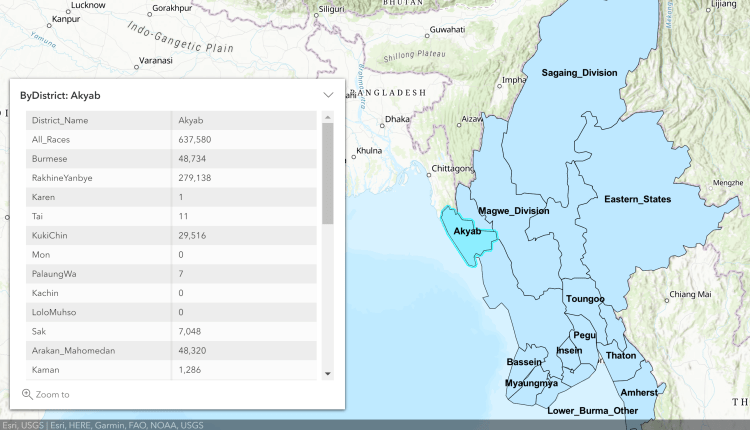
An example of my interactive ArcGIS map in use, providing the 1931 demographic data for each district of colonial Burma (Courtesy: Esri, ArcGIS Online).
Digital humanities methodology, including ArcGIS and data analysis, provided a crucial complement to my dissertation research. Using data from the 1931 British census of Burma, supplemented by indigenous primary sources including the newspaper New Burma, I have mapped and charted out the demographics of Burma in the 1930s in order to better understand the realities that lied behind competing leftist and rightist anti-colonial projects. I have created a visualization of this data, and the crucial interpretations they provide to my work, using Esri’s StoryMaps software.
Women Writers Project
In the spring term of 2019, I joined the Women Writers Project at Northeastern’s digital humanities center, the NULab for Texts, Maps, and Networks. The project’s goal is to bring a large corpus of texts written by pre-Victorian women writers out of the archive and to make them accessible to a wide audience of teachers, students, scholars, and the general reader. While assisting the project in digitizing the texts and standardizing them into the TEI (Text Encoding Initiative) format, I also performed research on the intersections of gender, race, and Orientalist thinking in Anglo-American women’s writing in the late eighteenth and early nineteenth centuries. In the product of my research, “‘Treasures More Permanent Than the Commercial:’ Orientalism & The Civilizing Mission in Women Writers Online,” I found that women contributed as much as men in building ideas about the civilizing mission and in constructing gender roles in the British and American imperial projects of the time.
Birth of Boston
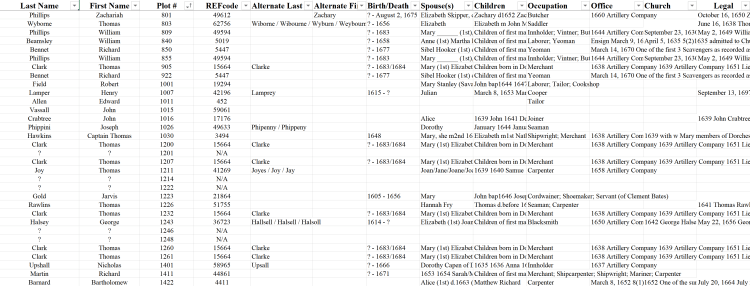
In the summers of 2018 and 2019, I served as a research assistant and founding member of the Birth of Boston project at the NULab under the supervision of Professor Christopher Parsons. This undertaking seeks to construct a more complex and inclusive understanding of early Boston by working closely with the Massachusetts Historical Society, using materials from their collections to investigate how historical narratives and data can be located geographically. My colleague Molly Nebiolo and I created a prototype interactive map of Boston in 1648 that allows users to click on land parcels to learn about each inhabitant that lived there. The map includes information on names, birth and death dates, occupations, family members, and events associated with the residents of each parcel. In so doing, the project has laid the groundwork for researchers to explore the stories of people of color and indigenous people, who had as fundamental a role in shaping the development of early Boston as famous English figures like John Winthrop or John Cotton did.
Breaking History Podcast
Breaking History Podcast is a forum where graduate students and scholars of history can share their research with their peers and with the general public. A production of the Northeastern University History Graduate Student Association, it was founded in 2016 by then-PhD-candidates James Robinson, Matthew Bowser, James Parker, Bridget Keown, and Thanasis Kinias.
You can find every episode on our Soundcloud.
The podcast includes interviews with renowned scholars in the Northeastern History Department and beyond. One of our most important projects was a three part interview with Dr. Kemal Taruc, who provided an oral history of his lived experience during the CIA-sponsored coup of General Suharto in Indonesia and the resulting anti-Communist massacres in 1965-1966.
 Matthew J. Bowser
